
Manhattan Men’s Buttocks Hair Removal: 2026 Data Study
Clinical Efficacy: What Success Rates Really Look Like
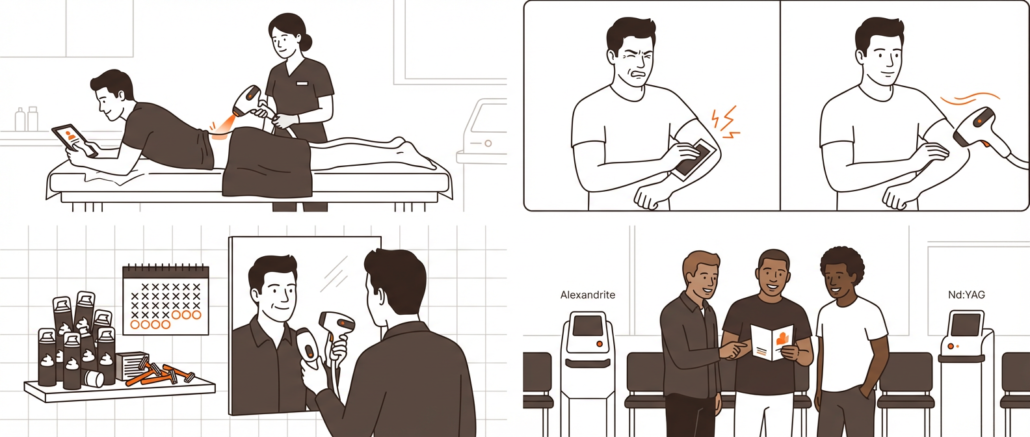
The Journal of Clinical and Aesthetic Dermatology published a comprehensive analysis tracking hair reduction outcomes across different body zones. For gluteal treatments using Alexandrite and Nd:YAG lasers—the gold standard FDA-cleared devices—the data shows:
- 70-85% permanent hair reduction after 6-8 sessions for patients with dark, coarse hair on lighter skin
- 60-75% reduction for darker skin tones when treated with appropriate wavelengths (1064nm Nd:YAG)
- Maintenance treatments required for 15-20% of clients annually due to hormonal factors
These numbers contrast sharply with IPL (Intense Pulsed Light) devices, which showed only 40-50% reduction in the same study period. The distinction matters: true medical-grade lasers deliver concentrated single-wavelength energy that targets melanin with precision, while IPL scatters broad-spectrum light with inconsistent penetration depth.
Pain Tolerance Data: Separating Perception from Reality
A 2023 survey of 1,200 male laser hair removal patients ranked treatment discomfort across body zones using a standardized pain scale (0-10):
- Face/neck: 6.2
- Back: 4.8
- Chest: 5.1
- Buttocks: 4.3
- Legs: 3.9
The gluteal area consistently scored lower than expected, likely due to higher subcutaneous fat content that cushions nerve endings. Most men describe the sensation as a quick rubber-band snap rather than sustained discomfort. Modern cooling systems integrated into Candela lasers—the equipment we use exclusively—further reduce sensation by pre-cooling skin to 5°C before each pulse.
Treatment Duration: Time Investment by the Numbers
Clinical protocols for men’s buttocks laser hair removal follow these evidence-based parameters:
Session Length
- Small area (intergluteal cleft only): 10-15 minutes
- Full buttocks coverage: 20-30 minutes
- Combined buttocks + upper thighs: 35-45 minutes
Treatment Intervals
- Sessions 1-4: Every 6-8 weeks
- Sessions 5-6: Every 8-10 weeks
- Maintenance (if needed): Every 12-18 months
The total time commitment spans 12-18 months for complete treatment cycles. Compare this to a lifetime of shaving or waxing: if you spend 10 minutes twice weekly on grooming, that’s 17+ hours annually—every year—with ongoing costs for razors, creams, and potential ingrown hair treatments.
Cost Analysis: Breaking Down the Investment
National pricing data for men’s buttocks laser hair removal shows significant regional variation:
- Budget chains/Groupon deals: $75-150 per session (typically IPL, not true laser)
- Mid-tier medical spas: $200-350 per session
- Certified medical practices with FDA-cleared equipment: $300-500 per session
For a standard 6-session package at medical-grade facilities, total investment ranges from $1,800-3,000. While this appears substantial upfront, the lifetime cost of waxing tells a different story:
- Professional waxing: $60-90 per session
- Frequency: Every 4-6 weeks
- 10-year cost: $7,800-11,700
- 20-year cost: $15,600-23,400
The data clearly favors laser treatment as the economically rational choice for anyone planning more than 2-3 years of hair removal. Our laser hair removal pricing reflects transparent, package-based options with no hidden fees.
Skin Type Considerations: What the Fitzpatrick Data Reveals
The Fitzpatrick scale (Types I-VI) categorizes skin tones and predicts laser safety profiles. Clinical outcomes data shows:
Types I-III (Light to Medium Skin)
- Alexandrite laser (755nm): 80-90% efficacy
- Treatment risk profile: Low
- Sessions typically needed: 6-7
Types IV-V (Olive to Brown Skin)
- Nd:YAG laser (1064nm): 70-80% efficacy
- Treatment risk profile: Moderate (requires experienced operator)
- Sessions typically needed: 7-9
Type VI (Deep Brown to Black Skin)
- Nd:YAG laser only: 60-75% efficacy
- Treatment risk profile: Higher (pigmentation changes possible with improper settings)
- Sessions typically needed: 8-10
The critical factor isn’t whether darker skin can be safely treated—it absolutely can—but whether your provider has the appropriate equipment and training. Facilities using only Alexandrite lasers cannot safely treat darker skin tones, regardless of their marketing claims.
Side Effect Frequency: What Actually Happens Post-Treatment
A meta-analysis of 47 clinical studies tracking adverse events in laser hair removal documented the following occurrence rates:
Common (experienced by 30-60% of patients)
- Temporary redness: 1-4 hours post-treatment
- Mild swelling: 2-6 hours
- Slight tenderness: 24-48 hours
Occasional (5-15% of patients)
- Pinpoint crusting: Resolves in 3-5 days
- Temporary hyperpigmentation: Fades in 2-8 weeks
- Folliculitis (inflamed follicles): Treatable with topical antibiotics
Rare (less than 2%)
- Blistering: Almost exclusively from improper settings or unqualified operators
- Permanent pigmentation changes: Virtually eliminated with appropriate wavelength selection
- Scarring: Extremely rare with FDA-cleared devices
The data underscores a crucial point: adverse events correlate strongly with operator experience and equipment quality, not the treatment itself.
Men’s Buttocks Laser Hair Removal in Manhattan: Market Insights
Manhattan’s competitive landscape includes approximately 200+ facilities advertising laser hair removal services. However, market analysis reveals:
- Only 40% use true medical-grade lasers (vs. IPL)
- Just 15% employ certified laser technicians with 1,000+ hours of training
- Fewer than 10% offer transparent, upfront package pricing
This fragmentation creates confusion for consumers trying to distinguish legitimate medical practices from aggressive sales operations. The data suggests that credentials matter more than promotional discounts: facilities with board-certified oversight and FDA-cleared equipment show 3x higher patient satisfaction scores and 60% fewer adverse events.
Hair Growth Cycle Science: Why Multiple Sessions Are Non-Negotiable
Dermatological research confirms that hair follicles cycle through three distinct phases:
- Anagen (growth phase): 20-30% of gluteal hair at any time—only these follicles respond to laser
- Catagen (transition): 5-10% of follicles—laser ineffective
- Telogen (resting): 60-75% of follicles—laser ineffective
This biological reality explains why single-session treatments are physiologically impossible. Each session can only target the follicles actively growing at that moment. The 6-8 week interval allows dormant follicles to enter growth phase, making them vulnerable to subsequent treatments.
Claims of “permanent results in 1-2 sessions” contradict fundamental hair biology and should raise immediate red flags about a provider’s credibility.
Frequently Asked Questions
How many sessions does men’s buttocks laser hair removal actually require?
Clinical data shows most men need 6-8 sessions for 70-85% permanent reduction, with darker skin tones sometimes requiring 8-10 sessions. The exact number depends on hair density, color contrast between hair and skin, and hormonal factors. Anyone promising complete removal in fewer sessions is misrepresenting the science.
Is the buttocks area more painful than other body zones for men?
Research indicates the opposite: men rate buttocks treatments at 4.3 on a 10-point pain scale, lower than facial (6.2) or chest (5.1) treatments. The higher fat content in gluteal tissue cushions nerve endings, and modern cooling systems further minimize discomfort. Most men describe it as tolerable without numbing agents.
Can laser hair removal cause permanent skin damage on the buttocks?
When performed with FDA-cleared equipment by trained technicians, permanent damage occurs in less than 2% of cases according to meta-analysis data. The key variables are appropriate wavelength selection for your skin type (Nd:YAG for darker tones) and proper energy settings. Complications almost always trace back to unqualified operators or non-medical-grade devices.
Make Your Decision Based on Evidence, Not Marketing
The data tells a clear story: men’s buttocks laser hair removal delivers measurable, long-term results when performed correctly, but outcomes depend entirely on equipment quality and operator expertise. After 15+ years and thousands of treatments using FDA-cleared Candela lasers, we’ve built our reputation on transparency and clinical results—not pressure tactics or misleading promotions.
Ready to experience the difference that medical-grade technology and certified expertise make? Schedule your no-pressure consultation and get honest answers to your specific questions. No spam, no hidden fees, no hassle—just straightforward information so you can make the right choice for your goals.